
When people picture dental implant treatment, they often focus on the implant placed in the jaw. That component is important, but it is not the part you will see or use when you smile and chew.
The visible part is the implant crown or another implant-supported restoration.
That is why dental implant crown planning often begins before surgery. The restorative dentist first considers where the finished tooth should be, how it should meet the opposing teeth, and how it should fit beside neighboring teeth and gums.
The surgical and restorative providers can then coordinate a plan that works toward that result while still accounting for bone, gum tissue, nearby structures, oral health, and other clinical factors.
For patients considering dental implants in Rochester, MN, understanding this sequence can make a multi-step treatment process easier to follow.
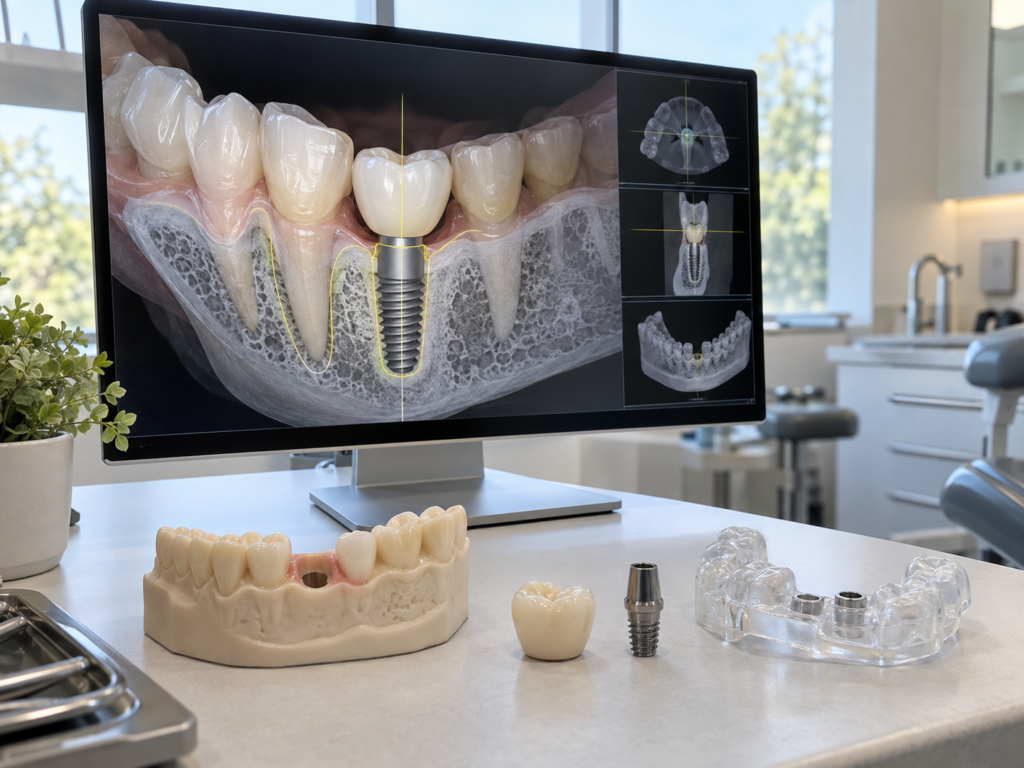
The Implant and Crown Have Different Jobs
A single-tooth implant restoration generally has three basic parts:
- The dental implant is placed in the jawbone by the surgical provider.
- A connecting component may join the implant to the restoration.
- The implant crown is the visible replacement tooth.
The implant provides support, while the crown needs to fit the available space and function within the patient’s bite.
For patients replacing one missing tooth, our information about single-tooth replacement explains how the implant and restoration work together.
Planning the crown before surgery does not necessarily mean that the permanent crown is manufactured ahead of time.
Instead, the dentist may plan the intended tooth position using digital records, models, scans, or another diagnostic representation before the implant is surgically placed.
What Does the Dentist Evaluate Before Implant Surgery?
The final crown is only one part of implant planning.
The dental team also needs to consider available bone, gum tissue, neighboring teeth, bite, restorative space, and important anatomical structures.
The Crown’s Position and Angle
The implant needs to support a restoration in the intended position.
If the implant is placed at an angle or location that does not relate well to the planned crown, the restorative dentist may have fewer options when designing the final tooth.
For some restorations, implant position can also affect where a screw-access opening would emerge or which type of crown design may be practical.
These decisions are case-specific. The important point for patients is that the surgical position and future crown should be considered together rather than as completely separate steps.
The Patient’s Bite
An implant crown must function with the teeth above or below it.
The dentist evaluates available space, how the teeth come together, and where chewing forces may be directed.
Patients who clench or grind their teeth may require additional planning because those habits can affect the forces placed on restorations.
If grinding is part of your dental history, our information about bruxism explains how those forces can affect teeth and restorations.
The goal is not to promise that a crown will never chip, loosen, or wear. Planning simply allows the bite to be considered before the final restoration is created.
The Gumline and Appearance
For teeth that show when a person smiles, crown position can affect how the restoration relates to neighboring teeth and the gumline.
The dentist may consider the planned crown’s width, length, alignment, and relationship to nearby teeth.
Gum thickness, contour, and tissue height may also influence what result is realistically possible.
These factors still matter for back teeth, even when appearance is less noticeable. Posterior implant crowns need enough room for a functional shape and must work with the rest of the bite.
Space for the Restoration
The dental team needs enough room for the implant crown and the components that connect it to the implant.
Too little vertical or horizontal space can make the restorative phase more difficult.
The width of the missing-tooth space and the positions of nearby teeth and roots may also influence planning.
Evaluating this before surgery gives the restorative dentist and surgical provider an opportunity to discuss limitations or alternative options early.
Access for Home Care and Maintenance
The final restoration also needs contours that allow reasonable cleaning.
Home-care recommendations depend on the restoration. A single implant crown may have different cleaning needs from an implant-supported bridge or denture.
After treatment, regular dental exams and cleanings allow the dental team to monitor the restoration, surrounding tissues, bite, and home-care routine.
Maintenance cannot guarantee how long an implant or crown will last, but it remains an important part of ongoing care.
How Is the Crown Planned Before Surgery?
The exact process depends on the number and location of missing teeth, oral health, anatomy, and treatment complexity.
A restoration-first workflow may include:
- Evaluation: The restorative dentist reviews the patient’s health history, goals, teeth, gums, bite, and missing-tooth space.
- Imaging and records: Dental X-rays, photographs, digital scans, impressions, or other records may be used depending on the case. CBCT imaging can provide three-dimensional information about bone and nearby anatomy when clinically appropriate.
- Restorative design: The dentist considers the intended position, size, and shape of the final crown. A digital design, model, or diagnostic setup may help visualize the proposed result.
- Surgical coordination: The restorative plan is shared with the provider responsible for implant placement. The providers consider how the proposed tooth position relates to available bone and surrounding anatomy. A surgical guide may be considered for selected cases.
- Final restoration: After implant placement and an appropriate healing period, the restorative dentist reassesses the site and creates the final crown or another implant-supported restoration.
The sequence is not identical for every patient.
Some people need additional care before implant placement. In other cases, the first proposed crown position may need to change after the team reviews anatomy or available space.
Planning allows those issues to be identified before or during coordination with the surgical provider.
Why Do the Restorative Dentist and Surgeon Coordinate?
Dental implant treatment can involve more than one provider.
The surgical provider evaluates the surgical site and places the implant.
The restorative dentist plans the tooth the implant is intended to support, completes the final restoration, and helps monitor the result afterward.
At Kelly Dentistry, we focus on implant evaluation, restorative planning, CBCT imaging when appropriate, coordination with the surgical provider, final implant restoration, and continuing follow-up. Surgical implant placement is completed by the appropriate local implant surgeon or specialist.
These stages should not be planned in isolation.
Information needs to move between the restorative and surgical providers so both are working toward the same intended restorative result.
The American College of Prosthodontists also emphasizes diagnosis, treatment planning, and coordination among providers as important parts of implant care.
Why Might the Implant Plan Change?
The proposed crown gives the dental team a restorative target, but the patient’s anatomy and oral health determine what is clinically possible.
Factors such as bone volume, tissue condition, nearby anatomical structures, available space, and overall health may affect the plan.
The team may need to modify:
- the crown design
- implant position
- treatment sequence
- type of final restoration
In some situations, the surgical provider may discuss additional preparation of the implant site. In others, a bridge, partial denture, or another restorative option may deserve consideration.
A change does not necessarily mean the original planning failed. It may simply reflect new clinical information or a need to choose a more appropriate option.
Questions to Ask During an Implant Evaluation
A dental implant evaluation is a good time to understand how the restorative and surgical stages fit together.
Consider asking:
- What type of final restoration are we planning?
- Who will perform each stage of treatment?
- How will my bite affect the plan?
- Is there enough space for the proposed crown?
- What imaging or records are needed, and why?
- Will I need a temporary tooth during treatment?
- How will the restorative dentist and surgical provider coordinate?
- What maintenance will the final restoration require?
The answers depend on the individual case.
A useful treatment plan should explain the expected roles, sequence, alternatives, and any details that cannot yet be confirmed.
Begin With the Tooth You Want to Replace
Dental implant crown planning begins with a practical question: What should the finished tooth need to do?
Considering the future crown before surgery helps the dental team evaluate implant position, available space, bite, appearance, hygiene, and provider coordination as parts of one connected plan.
At Kelly Dentistry, our role is centered on the restorative side of implant care, from evaluation and planning through the final implant restoration and long-term monitoring. We coordinate with local surgical providers when implant placement is needed.
If you are exploring dental implants, contact Kelly Dentistry to schedule an evaluation and discuss your restorative options.