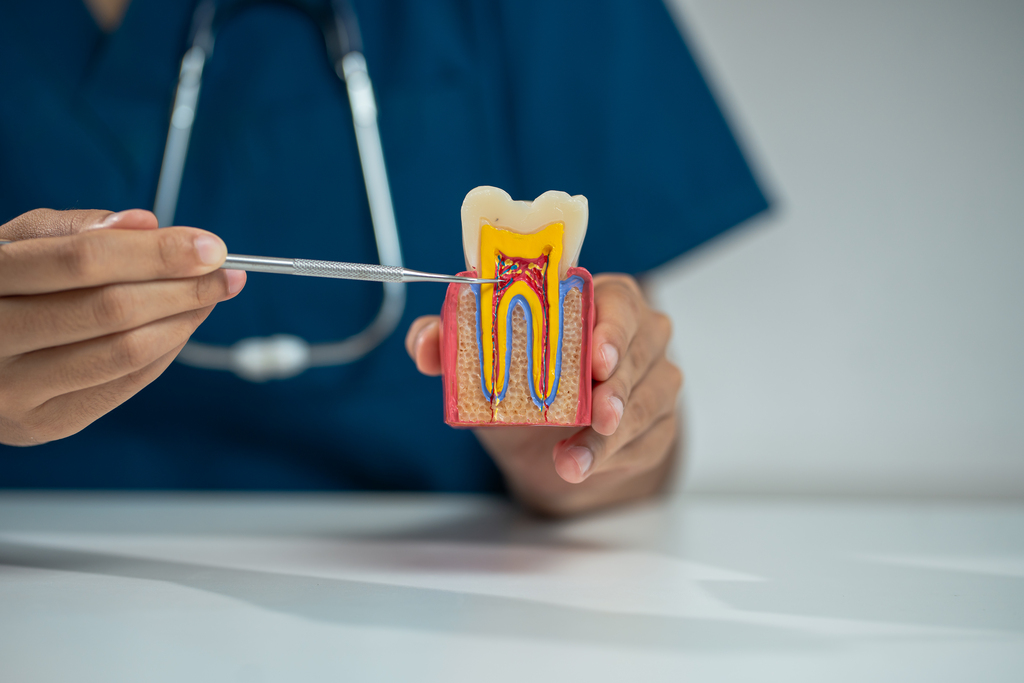
Root Canal Therapy

Your Smile Is Our Passion

Root canal therapy is needed when the nerve of a tooth is affected by decay or infection. In order to save the tooth, the pulp (the living tissue inside the tooth), nerves, bacteria, and any decay are removed and the resulting space is filled with special, medicated, dental materials, which restore the tooth to its full function.

Having a root canal done on a tooth is the treatment of choice to save a tooth that otherwise would die and have to be removed. Many patients believe that removing a tooth that has problems is the solution, but what is not realized is that extracting (pulling) a tooth will ultimately be more costly and cause significant problems for adjacent teeth.

Root canal treatment is highly successful and usually lasts a lifetime, although on occasion, a tooth will have to be retreated due to new infections.

Periodontal Disease
Periodontal Disease

Need To Schedule OR Have A Question?

Contact Form

Signs and symptoms for possible root canal therapy:

  • An abscess (or pimple) on the gums.
  • Sensitivity to hot and cold.
  • Severe toothache pain.
  • Sometimes no symptoms are present.
  • Swellingand/or tenderness.

Reasons for root canal therapy:

  • Decay has reached the tooth pulp (the living tissue inside the tooth).
  • Infection or abscess have developed inside the tooth or at the root tip.
  • Injury or trauma to the tooth.

What does root canal therapy involve?

A root canal procedure requires one or more appointments and can be performed by a dentist or endodontist (a root canal specialist).

While the tooth is numb, a rubber dam (a sheet of rubber) will be placed around the tooth to keep it dry and free of saliva. An access opening is made on top of the tooth and a series of root canal files are placed into the opening, one at a time, removing the pulp, nerve tissue, and bacteria. If tooth decay is present, it will also be removed with special dental instruments.

Once the tooth is thoroughly cleaned, it will be sealed with either a permanent filling or, if additional appointments are needed, a temporary filling will be placed.

At the next appointment, usually a week later, the roots and the inside cavity of the tooth will be filled and sealed with special dental materials. A filling will be placed to cover the opening on top of the tooth. In addition, all teeth that have root canal treatment should have a crown (cap) placed. This will protect the tooth and prevent it from breaking, and restore it to its full function.

After treatment, your tooth may still be sensitive, but this will subside as the inflammation diminishes and the tooth has healed.

You will be given care instructions after each appointment. Good oral hygiene practices and regular dental visits will aid in the life of your root canal treatment.

Frequently Asked Questions

How do I know if I need a root canal?
Common signs include severe tooth pain, lingering sensitivity to hot or cold, swelling or tenderness in your gums, a pimple-like bump on the gums, or darkening of the tooth. Sometimes there are no symptoms at all, which is why regular dental exams at our Rochester office are important for catching infections early. Dr. Adam or Dr. Laura will use digital X-rays and, when needed, CBCT imaging to confirm whether a root canal is the right treatment.
Most root canal appointments take about 60 to 90 minutes, depending on the tooth and the complexity of the case. Front teeth with a single canal are typically faster, while molars with multiple canals may take longer or require a follow-up visit. We use modern instruments and techniques to keep the procedure as efficient and comfortable as possible.
Root canals are actually designed to relieve pain, not cause it. We fully numb the tooth and surrounding area before starting, so most patients feel little more than mild pressure during the procedure. Many patients tell us the pain they felt before the root canal was far worse than the treatment itself.
Saving your natural tooth preserves your bite, chewing function, and jawbone structure, which can shift or deteriorate after an extraction. Replacing an extracted tooth with an implant or bridge typically costs more than a root canal over time. Your natural tooth will also look and feel better than any replacement option available today.
Delaying a root canal allows the infection to spread deeper into the tooth, surrounding bone, and potentially other parts of your body. This can lead to a painful abscess, bone loss, or the need for extraction instead of a root canal. Acting quickly gives you the best chance of saving the tooth with a straightforward procedure.
Some mild sensitivity or tenderness around the treated tooth is normal for a few days after your procedure, and over-the-counter pain relievers usually keep you comfortable. Avoid chewing on that side until the tooth is fully restored with a permanent filling or crown. Most patients are back to their normal routine the very next day.
A tooth that has had a root canal becomes more brittle because the internal blood supply is removed, which makes it prone to fracture under normal biting force. A crown protects and reinforces the tooth, restoring its full strength and appearance for long-term use. At Kelly Dentistry, we can often place a same-day CEREC crown to complete your restoration in one visit.
With proper care, a root canal treatment can last a lifetime, especially when followed up with a protective crown. Brushing twice a day, flossing, and keeping up with regular cleanings at our Rochester office will help extend the life of your treated tooth. On rare occasions, a tooth may need retreatment if a new infection develops years later.